Is Your Office Water Cooler as Clean as It Could Be?
What to Know About Water Quality and Maintenance
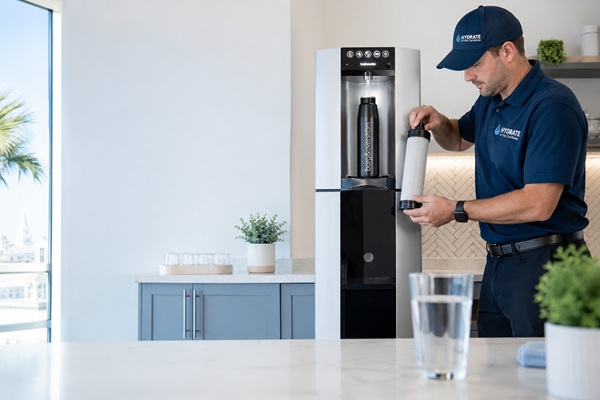
Most offices don't think twice about their water cooler. It's just there, doing its job, keeping people hydrated. But depending on the type of system you have, it's worth understanding how water moves through it and what good maintenance looks like.
The quality of your water isn't just about the source. It's also about what happens between the source and the glass.
Open Systems vs. Closed Systems: A Key Difference
One of the more important distinctions between water dispensing systems is whether they use an open or closed air system.Traditional 5-gallon jug coolers draw in ambient air to replace water as it's dispensed. This is simply how the system is designed to work. In most environments, this functions fine, but it does mean the system has regular exposure to the surrounding air, including dust and other particles common to any office. Routine cleaning and sanitization are important for managing this, which is why manufacturers typically recommend a regular maintenance schedule.
Closed point-of-use systems connect directly to a building's water line and dispense water in a sealed environment. Because outside air never enters the system, there's no exposure during jug changes or routine use.
The Importance of Keeping Water Moving
Any system that stores water in a reservoir benefits from regular cleaning. When water sits for extended periods, it can create conditions where biofilm, a thin layer of microorganisms, may develop on interior surfaces. This isn't unique to office water coolers. It's the same reason reusable water bottles need regular washing.A 2025 peer-reviewed study published in AIMS Microbiology analyzed roughly 70 international studies on water dispenser contamination and found that bacterial regrowth can appear within just a few days of disinfection. This comprehensive review of also found that water dispensers in commercial settings frequently showed higher bacterial contamination than the tap water supplying them, particularly when maintenance schedules lapsed.
The researchers, Hile, Leal, Dunbar, and Sinclair, recommended that internal lines and dispensing outlets be cleaned every two to four weeks under normal use, and weekly in higher-traffic settings. Notably, dispenser nozzles, the surfaces people press their cups and bottles against every day, showed some of the highest bacterial counts of any component tested.
The good news is that consistent maintenance largely addresses this. If you're not sure when your current cooler was last sanitized, it's a good time to check in with your service provider. The International Bottled Water Association recommends cleaning a five-gallon jug cooler at least every six weeks as a baseline.
What a Modern Point-of-Use System Does Differently
The dispensers Hydrate of the Carolinas installs are built by Borg & Overström, whose Totality system takes a multi-layered approach to hygiene at every stage, from manufacturing to daily use.DryChill technology eliminates the internal water reservoir entirely. Water is chilled on demand through a sealed aluminum cooling block, removing the variable of stored water between uses and the biofilm risk that comes with it.
Viovandt UV-C purification uses UV-LED light to inactivate harmful microorganisms as water passes through the system inline, before it reaches the point of dispense. Research published in Frontiers in
Microbiology found UV-C irradiation to be effective against both gram-negative and gram-positive bacteria in drinking water systems, and it works without adding any chemicals or leaving behind any residue. It's also mercury-free and maintenance-free.
Antimicrobial control panels use silver ion technology to resist biofilm development on the surfaces employees touch most. Given what research shows about nozzle and contact-surface contamination, this is a detail worth paying attention to in any shared-use setting.
Sterizen sanitization means every unit goes through an anti-microbial, anti-pathogen sanitizing process before leaving the factory, so it's ready to deliver clean water from day one.
For businesses also thinking about plastic waste, a 2024 Columbia University study found that bottled water contains an average of hundreds of thousands of detectable plastic fragments per liter, an additional reason some organizations are moving toward filtered, closed-loop alternatives.
A Simple Question Worth Asking
Whatever system your office uses, clean water starts with the source and continues through the equipment delivering it. A closed, filtration-based system removes some variables that open systems manage through regular maintenance.If you're curious whether a point-of-use system might be a better fit for your office, Hydrate of the Carolinas offers a free one-week trial for Charleston area businesses. Contact us today!